Direct answer
Treating material properties as device ratings can lead to an unsuitable oscillator or filter. YIG is yttrium iron garnet, a synthetic ferrimagnetic crystal, Y₃Fe₅O₁₂, used as a magnetically tunable resonator. For a saturated sphere with controlled orientation, temperature and loading, frequency is approximately linear with the bias field over the specified tuning region. Sphere shape removes directional differences in shape demagnetization; crystal anisotropy and assembly still matter. Device coverage, loss, noise and temperature ratings belong to the complete assembly, not the chemical formula.
Key takeaways
- A YIG resonator is tuned by a magnetic field, not by changing a physical dimension.
- That is what buys multi-octave tuning from a single device.
- YIG has an exceptionally narrow ferrimagnetic resonance linewidth, which is the source of its high Q.
- The magnetic circuit and driver strongly influence wide-step settling and power; crystal temperature and orientation remain part of performance.
Most microwave resonators are tuned by geometry. A cavity resonates at a frequency set by its dimensions, and a dielectric resonator by the size and permittivity of its puck. To move the frequency, something physical has to move, or the part has to be replaced.
A YIG resonator does not work that way. It tunes by magnetic field rather than by geometry, which is the whole reason it exists in a signal chain and the premise behind the rest of the YIG technology guides.
| Term | What it names | Continue with |
|---|---|---|
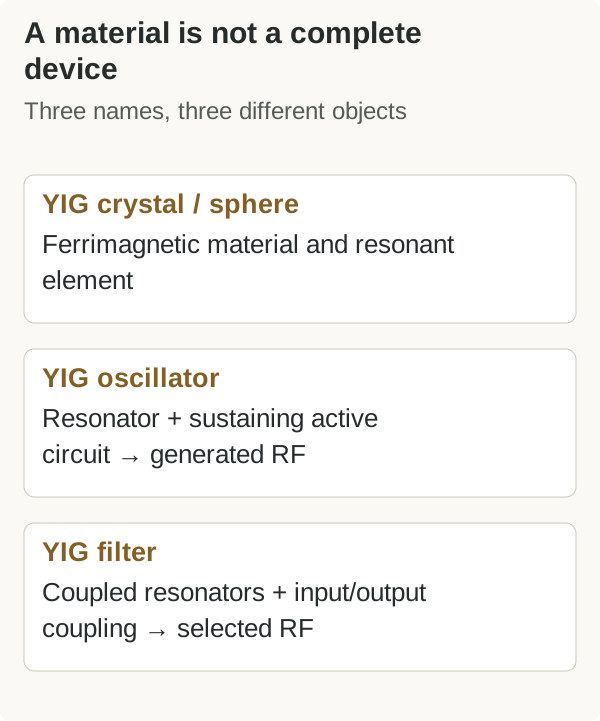
| YIG material or sphere | The ferrimagnetic crystal/resonator | Material and measurement conditions below |
| YIG oscillator | A resonator coupled to an active circuit that sustains an RF output | How the oscillator works |
| YIG filter | Coupled resonators that select frequencies from an applied RF signal | YIG filter guide |
The material
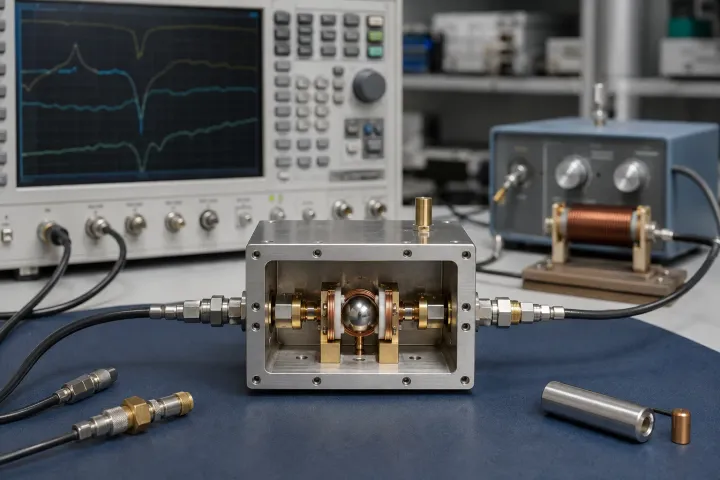
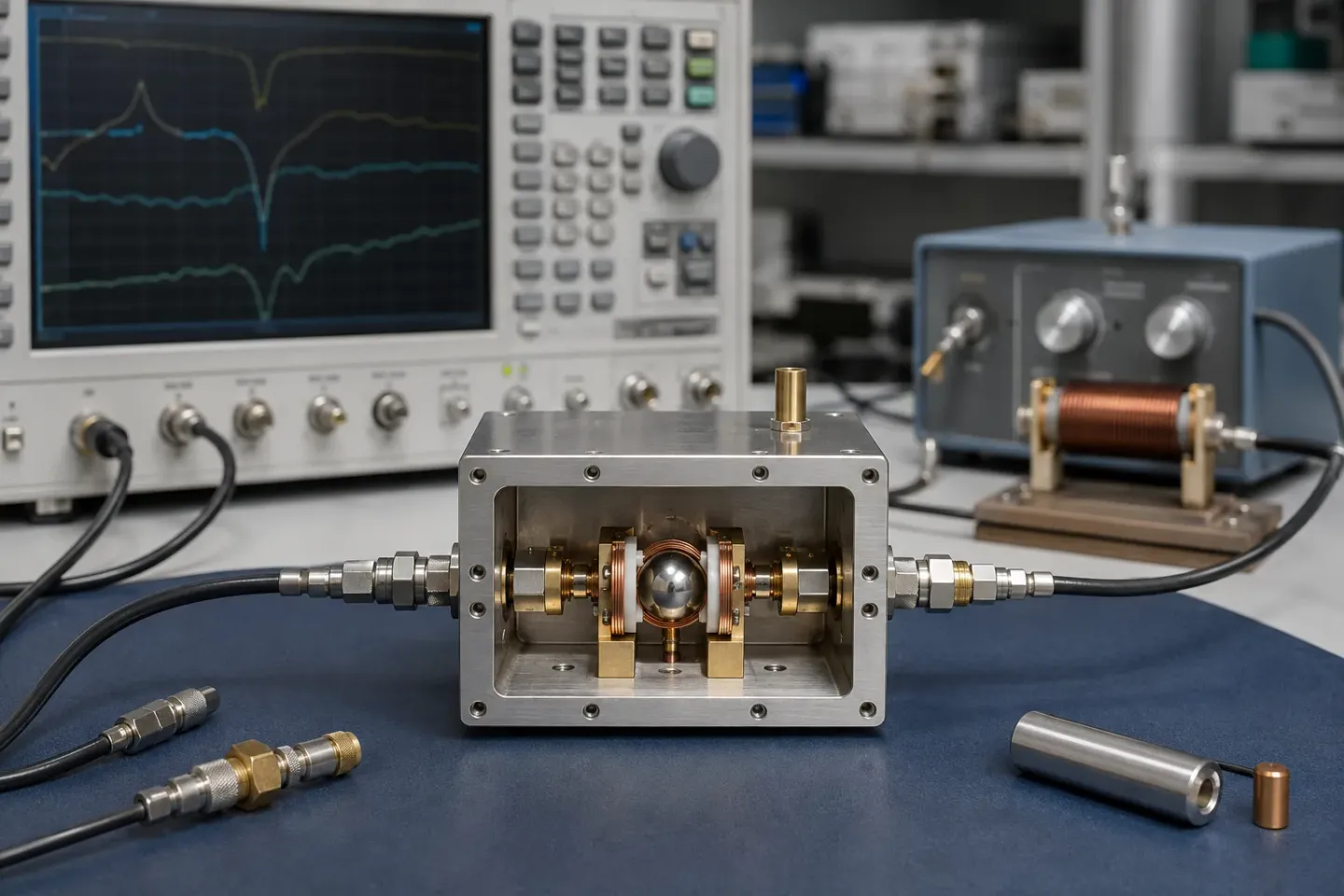
Yttrium iron garnet is a synthetic ferrimagnetic crystal, Y₃Fe₅O₁₂, and it is an electrical insulator. In a microwave device it is usually a polished sphere well under a millimetre across, held on a small rod inside a coupling loop.
Two properties matter. First, the crystal has an exceptionally narrow ferrimagnetic resonance linewidth — narrower than other practical ferrites — and that narrow linewidth is what gives a YIG resonator its high unloaded Q. Second, it is an insulator, so it does not carry the eddy-current losses that a conducting magnetic material would at microwave frequencies.
What the name and crystal structure mean
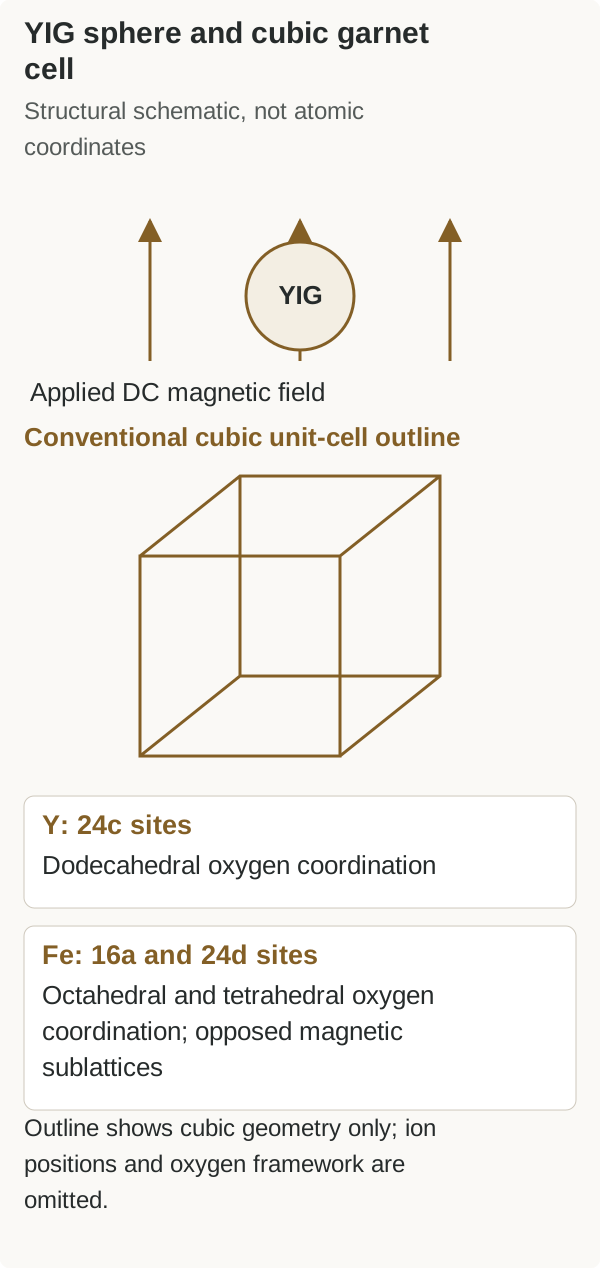
YIG expands to yttrium iron garnet, with the formula Y₃Fe₅O₁₂. “Garnet” names a crystal-structure family, not an oscillator circuit. Gorbatov and colleagues’ Physical Review B study (2021) describes the cubic structure and its different ion sites: yttrium occupies dodecahedral sites, while iron occupies octahedral and tetrahedral sites. The iron sublattices are oppositely aligned and unequal, leaving a net magnetization: ferrimagnetism, rather than all iron moments simply pointing the same way.
That paper reports an experimental Curie temperature of 560 K from the literature it compares with its calculations. This material transition is not a permissible oscillator operating-temperature rating; packaging, electronics, magnet and calibration limits still come from the device datasheet.
Magnetic resonance and linewidth
An applied static field establishes the conditions for magnetic resonance. A narrow resonance can support a high-Q frequency-selective element, but a linewidth belongs to a stated sample and measurement method. In Krupka and colleagues’ 2017 study, extracting the ferromagnetic-resonance linewidth from measured Q requires accounting for losses in the whole measurement system. Radiation, enclosure and dielectric losses must not automatically be attributed to the YIG material.
For a material comparison, request the linewidth definition, field or frequency units, bias, frequency, temperature and sample geometry. Do not carry a paper’s sample linewidth into a complete oscillator’s phase-noise specification. Crystal anisotropy and device loading also mean the simple field-to-frequency relation is an engineering approximation, not an exact prediction for every orientation and assembly.
The tuning mechanism
Place the sphere in a DC magnetic field and the electron spins precess about the field direction. Under the saturated-sphere approximation with controlled orientation, temperature and loading, the resonance varies approximately linearly with bias field. Drive the coupling loop at that frequency and energy couples strongly into the sphere; drive it away from that frequency and it does not.
The consequence is the useful part. The resonant frequency tracks the applied magnetic field, and nothing physical has to move. Change the current in an electromagnet and the resonance moves with it, smoothly and repeatably, across a range no fixed-geometry resonator can cover.
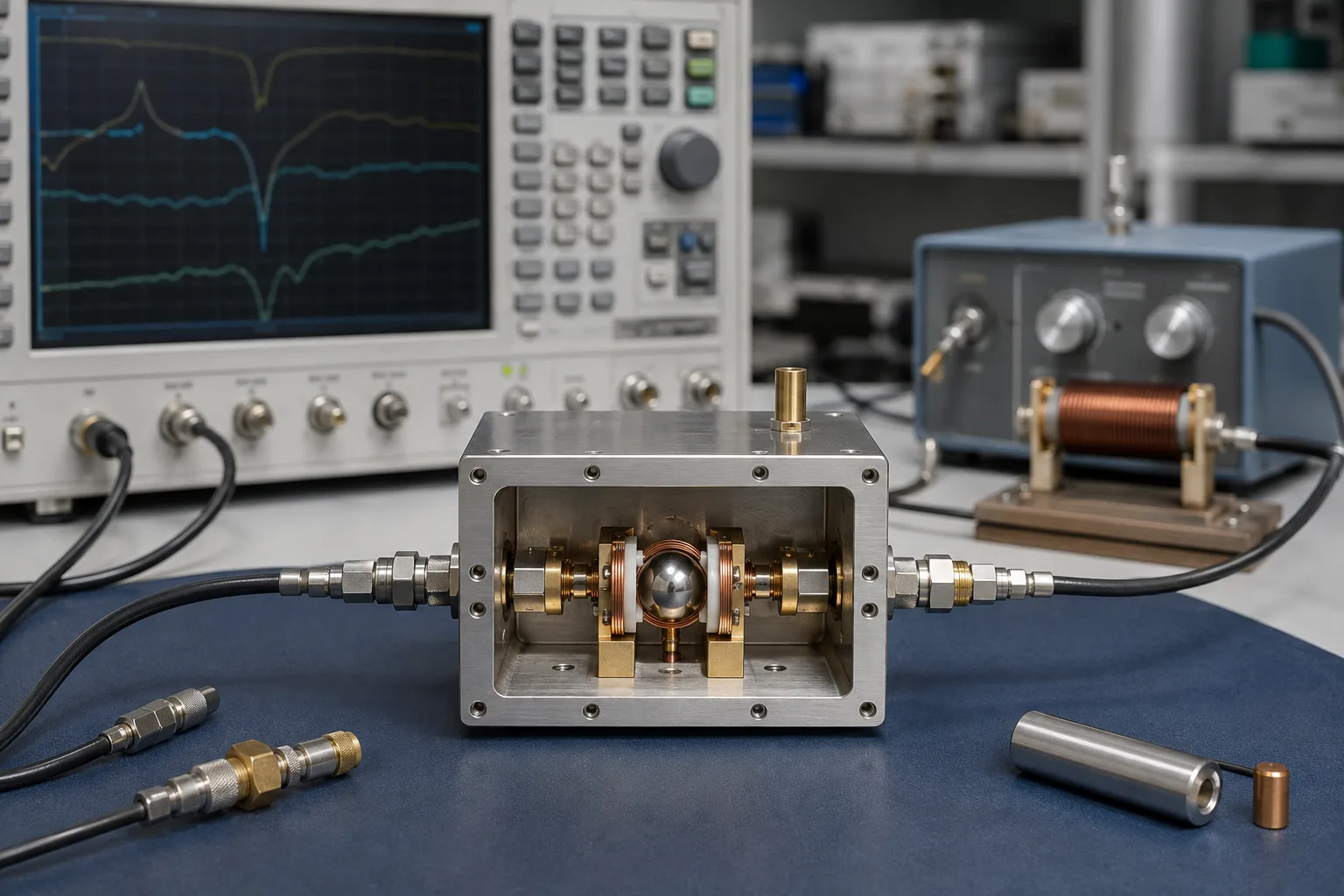
That is why a single YIG-tuned oscillator can be specified over ranges like 2–8 GHz or 8–18 GHz, and why commercial parts collectively cover roughly 700 MHz to 40 GHz.
Near-linear tuning is useful, but it does not remove calibration. Field uniformity, crystal anisotropy, orientation, temperature and RF loading affect the relationship; check the specified region and error. Krupka et al., page 2 states the orientation-dependent anisotropy term, while Micro Lambda’s technology description, page 1 explains orientation and temperature control.
What the magnet costs you
The crystal is the elegant part. The magnet is where the engineering compromises live.
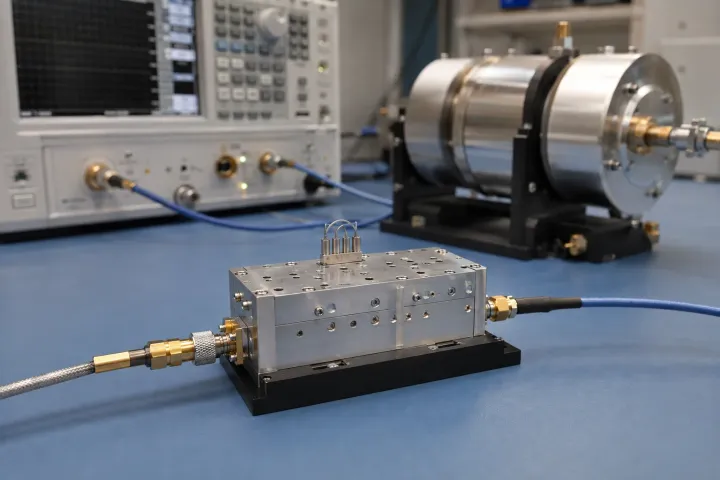
The tuning field comes from an electromagnet coil, and that coil has inductance. Changing the field means changing the current, and changing the current takes time — so a YIG device’s tuning speed is set by the magnetic circuit and its driver, not by the resonator. The coil also dissipates power continuously to hold a frequency, and it makes the device sensitive to external magnetic fields and to its own thermal history.
If you are comparing a YIG source against a VCO, this is the trade you are actually making: exceptional tuning range and spectral purity, paid for in settling time, power and package size.
Why a sphere, and why polished
A sphere has no preferred shape-demagnetizing axis. Crystal axes still produce anisotropy, and coupling and mounting can affect the assembled response. Control orientation rather than assuming that a spherical shape makes it irrelevant.
Manufacturing prepares and polishes the sphere; measured linewidth depends on the sample and measurement conditions. The manufacturing description below documents the process without assigning a universal loss or cost contribution.
What it is not good at
| Property | Consequence | Why |
|---|---|---|
| Tuning range | Octave or more from one device | Frequency follows the field, not a dimension |
| Tuning linearity | Approximately linear in the specified region | Controlled field, orientation, temperature and loading |
| Unloaded Q | High | Exceptionally narrow ferrimagnetic resonance linewidth |
| Tuning speed | Slow — milliseconds for wide steps | The tuning coil is inductive |
| Standby power | Continuous | Holding a frequency means holding a coil current |
| Size | Large | The magnet, not the crystal, sets the package |
| Magnetic immunity | Poor | The control variable is a magnetic field |
Qualitative comparison of the device class against fixed-geometry resonators. For values, work from a specific part's datasheet.
Read that table as one trade repeated seven times. Field tuning provides continuous movement of the resonance, while the magnet and driver impose control and power requirements. The material and assembly still contribute temperature and loading effects.
Where it shows up
- Oscillators. Wideband, low phase noise local oscillators and sweepers. See how YIG oscillators work.
- Filters. Tunable bandpass and band-reject filters used as preselectors ahead of a broadband receiver. A YIG-tuned filter moves its passband with the applied field. Bandwidth, insertion loss and rejection depend on the structure and operating frequency; no generic loss or width is retained here. Compare a cavity or switched bank when the coverage permits it.
- Discriminators and limiters. Less common, but the same resonance is the mechanism.
For the device-level specifications and how to read them, start with the YIG oscillator component guide. For the parameter that most often decides whether a source is acceptable, see phase noise. The oscillator loop itself, including why there are two tuning coils rather than one, is covered in how YIG oscillators work.
Where a YIG device sits relative to mixers, filters and amplifiers is laid out in the RF signal chain section, and the buying considerations for parts with long production lives are in sourcing and quality.
From material property to component decision
An oscillator uses the resonator in a sustaining RF circuit; a filter uses coupled resonators to select an applied signal. Their shared material does not make oscillator noise or filter rejection interchangeable.
Separate temperature responsibilities. Crystal temperature changes the resonator behavior; magnetic-circuit and driver temperature changes affect the applied field and calibration. Evaluate both in the installed assembly using the oscillator mechanism guide.
Takeaway: Choose from model-level ratings and a system test plan, using the source comparison or filter comparison for the relevant device.
From grown crystal to a YIG sphere
Matesy’s manufacturing description describes growing single crystals from high-temperature solutions, cutting slices and cubes, rounding them and polishing the surface. The sphere is the prepared material resonator; the coupling loops, magnet and active electronics around it determine how that material is used.
Frequently asked questions
Is YIG a natural mineral?
No. Yttrium iron garnet is synthetic. It shares the garnet crystal structure, which is where the name comes from, but it is grown for the purpose rather than mined.
Why a sphere rather than a slab?
A sphere removes directional differences in shape demagnetization. It does not remove crystal anisotropy or coupling and mounting effects; crystal orientation, temperature and assembly still require control.
Does YIG conduct?
No. YIG is an insulator, which is part of why its magnetic losses are so low at microwave frequencies.
Sources
- Electromagnetic YIG Oscillators (Wide Tuning Range) — Micro Lambda Wireless Accessed August 28, 2026.
- The Role of the Preselector Filter in a Receiver Front End — RF Essentials Accessed August 28, 2026.
- Gorbatov et al. (2021): Magnetic exchange interactions in YIG, pages 2 and 6 — Physical Review B Accessed October 8, 2026.
- Krupka et al. (2017): publisher PDF, orientation and linewidth — Scientific Reports Accessed October 8, 2026.
- YIG Cubes and Spheres, Design and Function — Matesy Accessed October 8, 2026.
- Technology Description: YIG Tuned Oscillators, page 1 — Micro Lambda Wireless Accessed October 8, 2026.