Key takeaways
- A facility announcement gives supply context; it does not qualify a cleaning process.
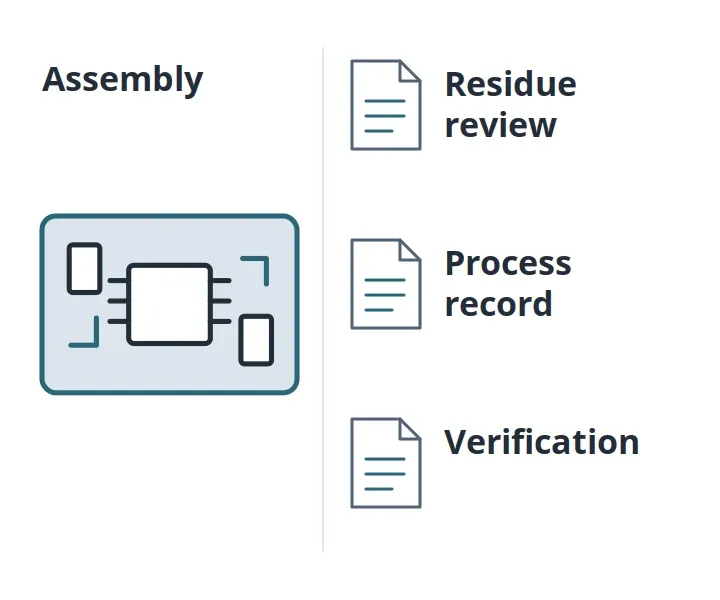
- Review residue, assembly materials and the downstream process together.
- Visual examination and electrochemical evidence answer different questions.
Changing a cleaning chemical without checking the assembly process can leave its acceptance evidence incomplete. Evaluate the residue, materials and verification plan together; a supplier’s new facility does not qualify that change for your board.
The KYZEN Penang Southeast Asia headquarters facility announcement is a reason to review supply and technical-support questions, not evidence that an assembly is cleaner. This primer helps US process and supplier-quality engineers ask why post-solder cleaning might matter, what a “no-clean” label leaves to evaluate, and how different verification approaches fit a decision. It concerns assembled boards rather than a household repair recipe. Within our component guides, it addresses manufacturing evidence for an assembly, not a new component specification.
What did the Penang announcement say, and who should act?
Circuits Assembly and SMT Today carried KYZEN’s announcement on October 1, 2026 describing a new Southeast Asian headquarters and production facility in Penang, Malaysia. The announcement presents increased production capability, delivery and technical support as intended benefits. Repetition in trade publications is not independent evidence that those benefits have occurred for a customer’s order.
| Source or review | Date | What the record supports |
|---|---|---|
| Circuits Assembly publication | October 1, 2026 | Publication of the KYZEN facility announcement |
| SMT Today publication | October 1, 2026 | Coverage of the same underlying announcement |
| This process-source review | October 8, 2026 | Questions for assessing a proposed assembly-cleaning change |
| US product or delivery commitment | Date to be confirmed | Requires product-specific supply documentation |
| Reader | Why the news might prompt a review | Evidence to request separately |
|---|---|---|
| Process engineer | A chemistry or support discussion is being revisited | Applicable product instructions and process evaluation |
| Supplier-quality engineer | A proposed process or supply change enters the program | Change record and assembly-specific acceptance evidence |
| Buyer serving a US program | Regional production is mentioned in the announcement | Exact product source and written delivery confirmation |
The sourcing and quality framework is useful for keeping those supply records distinct from a process result. No US delivery improvement or cleaning-performance improvement is established by this review.
Takeaway: Treat the facility news as a question trigger, then ask for the record relevant to your assembly and supply route.
Why review residues if the soldering material says no-clean?
A no-clean designation does not finish the engineering review of an assembly. IPC-CH-65B’s public introduction identifies tighter spacing, reliability requirements, dense packaging and underfill adhesion among the issues that complicate a blanket decision to stop cleaning. It also reminds readers that upstream soils and handling remain part of the manufacturing context.
The cleaning question starts with material left by the process. IPC-9202’s public scope describes flux and other residues on external surfaces after soldering as possible contributors to electrochemical reactions that adversely affect reliability. Cleaning evaluation asks whether removal is needed and whether the proposed process produces an acceptable condition for the assembly. The public introduction also links the decision to upstream soils and later operations such as underfill adhesion. A change therefore needs an assembly-level reason, not just a cleaner-looking surface.
In IPC-CH-65B’s historical introduction, no-clean is associated with low-residue flux or paste. That label does not establish the condition of all other materials and handling steps. It also does not establish that every board needs washing: retain the actual assembly requirements in the decision.
| Question about the assembly | Information to record | Decision it helps prepare |
|---|---|---|
| What materials and operations precede inspection? | Approved soldering materials, process steps and handling | Identify the process being evaluated |
| What residue is present or expected? | Material identity and inspection observations | Select the evidence needed to assess it |
| What downstream operation follows? | Coating, underfill or other specified step | Check the applicable compatibility requirements |
| What acceptance applies? | Product requirement and agreed test plan | Define the decision before evaluating the result |
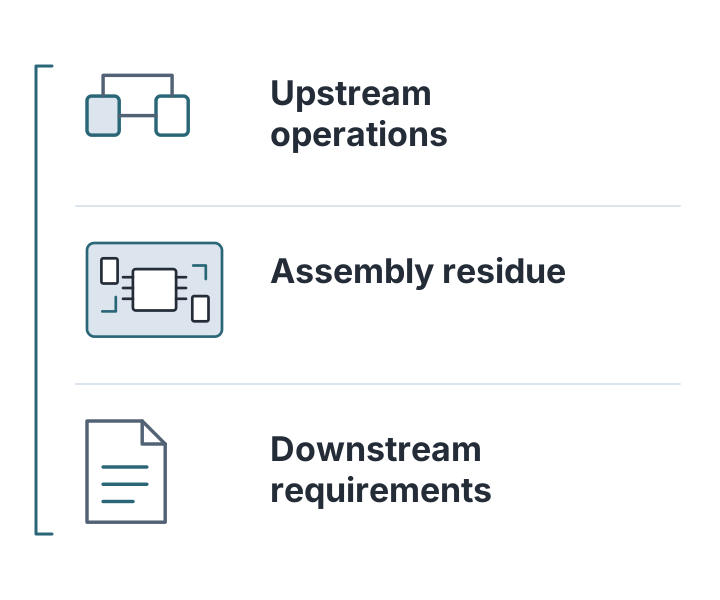
Common mistake: Replacing the assembly review with either “no-clean means no evaluation” or “all boards should be cleaned.” Neither follows from the cited introduction.
Our engineering guides use the same distinction between a general technical label and the conditions governing a specific requirement. For an outsourced frequency-converter assembly, record the manufacturing evidence alongside its electrical acceptance plan.
Takeaway: Decide what evidence the particular assembly needs before deciding whether to add or change cleaning.
Which questions should precede a chemistry change?
A chemistry change is a process-review task. Identify the proposed product, the material it is intended to remove and the assembly it will contact, then obtain the applicable instructions. The checklist below organizes questions for the process owner; it is not a concentration, temperature, dwell-time or rinsing prescription.
| Review field | Question to put in the change record | Expected response |
|---|---|---|
| Residue and chemistry | Which residue is the proposed product intended to address? | Product-specific documentation and material identification |
| Assembly materials | Which board and component materials are included in the evaluation? | Defined assembly scope and compatibility evidence |
| Equipment and process sequence | How will the proposed process be implemented? | Applicable operating procedure and controlled settings |
| Downstream requirement | What condition does the next operation require? | Requirement owner and relevant acceptance record |
| Verification | What result will authorize the change? | Defined test method, specimens and decision criteria |
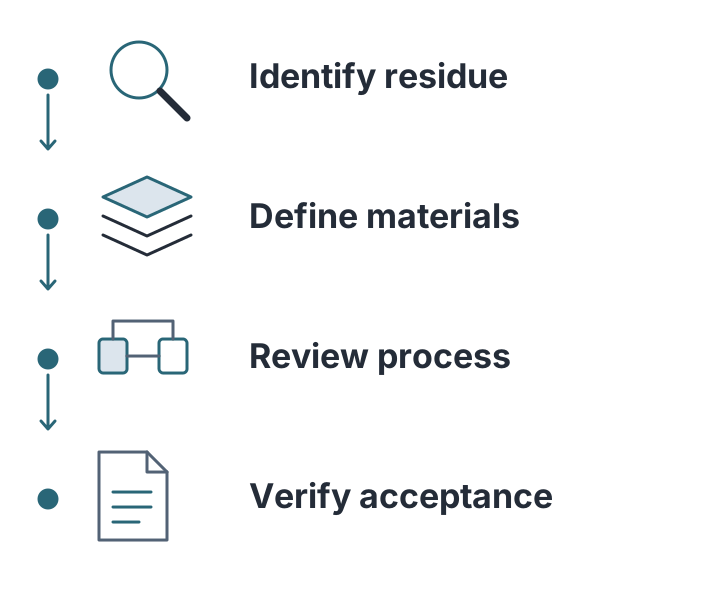
Put the criteria in writing before looking at a trial’s appearance. If the assembly uses YIG filters or YIG oscillators, this article does not establish that those complete devices are washable. Their applicable handling and assembly documentation remains a separate input.
The obsolete-component sourcing guide explains why documentation, inspection and electrical tests have different jobs. A chemistry product sheet likewise does not finish the acceptance record for the assembled article.
Takeaway: Define the proposed change and its acceptance evidence before assigning process settings.
What do cleanliness-verification approaches actually tell you?
Different observations answer different questions. IPC-9202’s public contents separates visual examination, ionic analysis and surface insulation resistance testing. Its scope describes recording changes in surface insulation resistance on a representative assembly test vehicle to evaluate possible adverse electrochemical effects from residues. The public excerpt supports that distinction but does not supply a complete operating procedure or universal acceptance limit.
| Approach | Question to define in the evaluation plan | Evidence boundary |
|---|---|---|
| Visual examination | What visible condition was observed under the defined inspection setup? | Appearance alone does not complete the other evaluations |
| Ionic analysis | What ionic result does the chosen method report for the defined specimen? | Preserve method, specimen and extraction scope with the result |
| Surface insulation resistance, or SIR | In the cited IPC-9202 protocol, what changes in surface insulation resistance are recorded on the representative assembly test vehicle? | Keep test conditions, assembly representation and protocol scope attached |
| Process record | Which materials and controlled steps produced the specimen? | Needed to connect a result to the proposed change |
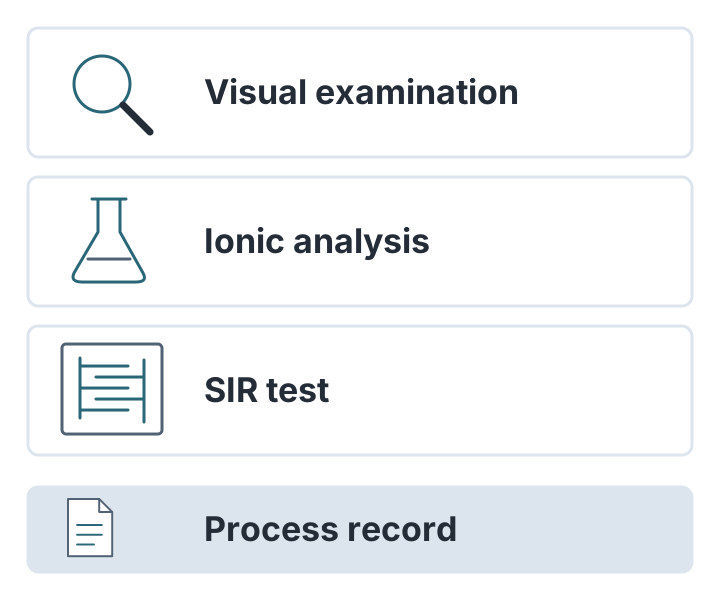
Ask the responsible laboratory and quality owner which methods and criteria apply to the product. Keep any interpretation within that defined scope. The sources methodology explains how this site matches claims to evidence and handles unreadable material, and our fact-checking policy provides a route for reporting a misapplied reference.
Common mistake: Recording “looks clean” in the same field intended for an electrochemical acceptance result. Preserve the different observations instead of renaming one as the other.
Takeaway: State the question each method answers, and retain the test conditions with its result.
When should a team act, and what remains uncertain?
The dated announcement can prompt a supplier conversation now. A process change should follow the applicable evaluation and approval record, while a purchasing date should follow the supply confirmation for the exact product. Neither timeline can be filled in from the Penang headline alone.
| Action | Timing to use | Person and record needed |
|---|---|---|
| Review relevance of the news | After the October 1 announcement | Buyer checks actual product and supply route |
| Evaluate a proposed cleaning change | Before introducing it into the approved process | Process owner defines specimens and evaluation |
| Accept the process change | After the applicable evidence and approvals | Quality owner records the product-specific decision |
| Schedule supply to a US program | Date to be confirmed | Supply contact gives written product and delivery details |
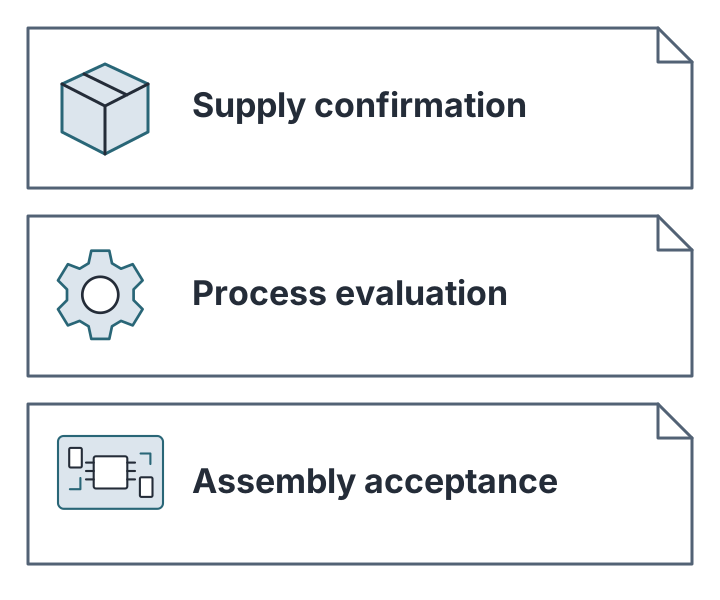
Open items include the relevant supply route, product availability, compatibility evidence and the acceptance plan for the reader’s actual assembly. None is resolved by this article. The editorial policy describes the site’s role as an independent technical publication rather than a chemistry supplier or a testing laboratory.
Takeaway: Confirm supply and process suitability through their respective records before setting an introduction date.
When this does not apply
This primer is not a procedure for cleaning an energized product, repairing a consumer motherboard or changing an approved production recipe. It provides no solvent ratios, numerical contamination limits or claim of compliance. It also does not assert that a particular chemical is suitable for every PCB assembly or that cleaning is always required.
The review uses the public IPC-CH-65B introduction and IPC-9202 scope. It does not interpret unseen IPC J-STD-001 or IPC-5704 clauses, prescribe a required test or claim that the historic public excerpts are the current revisions applicable to a contract.
Takeaway: Use this page to frame a process review; use the applicable controlled documents to execute and accept it.
Method and sources
The event is attributed to KYZEN’s announcement as carried by Circuits Assembly and SMT Today; the two publications are treated as one underlying announcement. The process material is drawn from IPC’s publicly accessible introduction and scope pages, checked on October 8, 2026. The tables and diagrams are an editorial organization of evaluation questions. No assembly was cleaned, no chemical comparison was tested and no site-specific delivery effect was independently established.
Further reading
- Sourcing and quality — Keep supply documentation separate from product acceptance.
- Engineering guides — Attach conditions and evidence to each acceptance requirement.
- Frequency-converter guide — Define the RF assembly’s electrical requirements alongside its process records.
Frequently asked questions
How to properly clean a PCB?
For a manufactured assembly, begin with the approved materials, process instructions and acceptance plan. Identify the residue and determine whether the proposed cleaning process is compatible with the assembly. This guide provides evaluation questions, not a universal cleaning recipe or a repair procedure.
Can I use 70% isopropyl alcohol to clean a circuit board?
The concentration in the question is not a recommendation from this guide. This review does not establish that mixture's suitability for an assembled product. Follow the applicable material and process instructions, and evaluate the cleaning result against the assembly's acceptance requirements before changing an approved process.
Does WD-40 clean circuit boards?
This article has not assessed that product for electronics cleaning and does not recommend substituting it into an assembly process. Check the exact product's documentation and the assembly's approved procedure. A household product name is not evidence of compatibility or acceptable post-cleaning residues.
Which chemical is used for PCB cleaning?
There is no chemical selected by this guide for every assembly. The residue, materials, equipment and required downstream condition determine the evaluation. Identify the specific chemistry and its technical documentation, then qualify the proposed process under the requirements agreed for that assembly.
Sources
- Kyzen Opens New Penang Office to Continue Success in Malaysia — Circuits Assembly Accessed October 8, 2026.
- KYZEN Opens New Penang Office to Continue Success in Malaysia — SMT Today Accessed October 8, 2026.
- IPC-CH-65B, public contents and introduction — IPC Accessed October 8, 2026.
- IPC-9202, public contents and scope, October 2011 — IPC Accessed October 8, 2026.